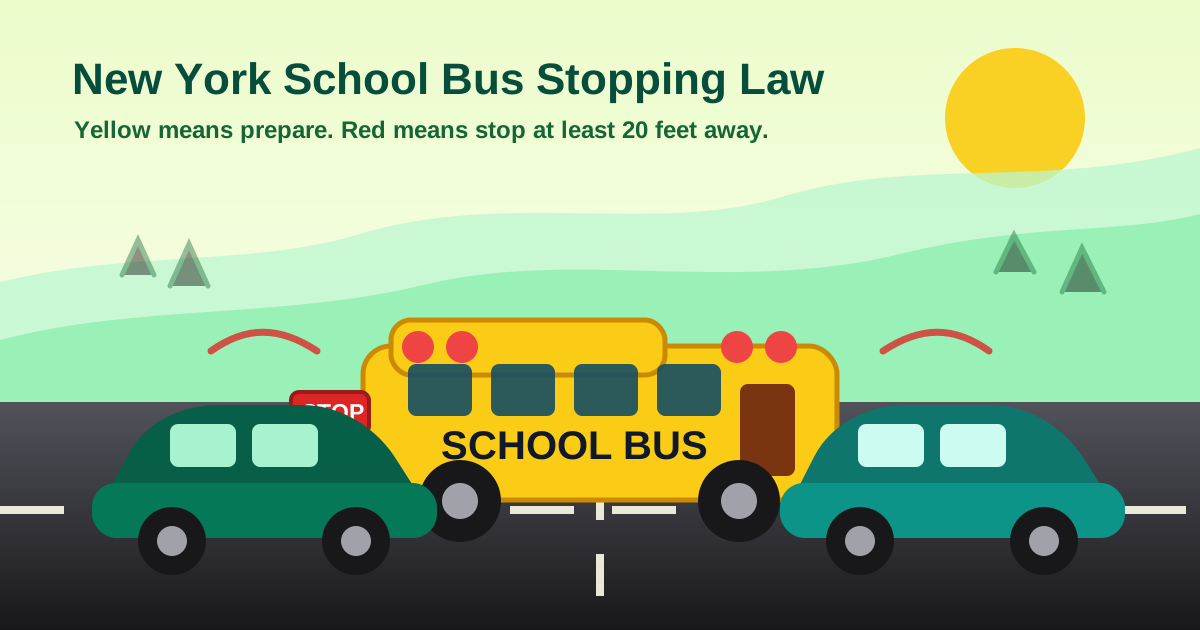
New York's rule is broader than many drivers expect. When a school bus is stopped to receive or discharge passengers and its red lights are flashing, drivers approaching from either direction generally must stop. This applies even on many divided and multi-lane roads.
The safest habit is simple: yellow lights mean prepare to stop. Red lights mean stop and remain stopped.
New York Rule at a Glance
- Yellow lights: slow down and prepare for a complete stop.
- Red lights: stop before reaching the bus.
- Stop at least 20 feet away.
- Traffic from both directions generally must stop.
- Remain stopped until the red lights stop, the stop arm withdraws and children are clear.
Quick Answer
In New York, drivers approaching a stopped school bus with flashing red lights must generally stop from either direction. Stop at least 20 feet before reaching the bus.
The rule applies on two-lane roads, multi-lane roads, divided highways, public streets, certain private roads, parking lots and school grounds. Remain stopped until the red lights stop flashing, the stop arm is withdrawn and it is safe to proceed.
Do not assume that a median or additional lanes automatically allow you to continue.
Key Takeaways
- Flashing yellow school-bus lights mean the bus is preparing to stop.
- Begin slowing immediately and prepare for a full stop.
- Flashing red lights mean traffic must stop.
- Stop at least 20 feet from the bus.
- Drivers approaching from both directions generally must stop.
- The rule applies on divided and multi-lane highways.
- Parking lots, school grounds and certain private roads may be covered.
- Stay stopped until the red lights are off, the stop arm withdraws and children are clear.
- Stop-arm cameras may result in an owner-liability notice.
- A defensive driving course does not automatically dismiss or erase a violation.
New York DMV states that drivers must stop for a school bus displaying flashing red lights regardless of the direction of approach and must remain at least 20 feet away.
What Do Yellow School-Bus Lights Mean?
Flashing yellow or amber lights mean the school bus is preparing to stop. They are an advance warning, not permission to speed past before the red lights activate.
When yellow lights begin flashing, release the accelerator, check the rearview mirror, increase following distance, prepare to stop smoothly and watch both sides of the road for children. Do not accelerate to beat the red lights.
Practical Tip
When you see yellow school-bus lights ahead, decide where you will stop before the red lights activate. Planning early reduces hard braking and rear-end collision risk.
What Do Flashing Red Lights Mean?
Flashing red lights mean the bus has stopped for passengers. Drivers approaching the bus must come to a complete stop before reaching it. In New York, motorists should stop at least 20 feet away.
Remain stopped while the red lights are flashing, the stop arm is extended, children are entering or leaving the bus, children may still be crossing, the bus has not resumed travel and the bus driver or police officer has not clearly directed traffic to proceed.
Do not begin moving simply because the last visible child reached the sidewalk. Another child may be crossing in front of the bus, behind it or from the opposite side of the road.
Do You Have to Stop on the Opposite Side of the Road?
Yes, in most New York school-bus situations. Drivers approaching from the opposite direction must generally stop when the bus's red lights are flashing.
This surprises drivers who learned to drive in states where vehicles on the opposite side of a divided highway may continue. New York's rule applies broadly to two-lane roads, four-lane roads, multi-lane roads and divided highways.
Do not assume that painted lines, a turning lane, a grass median or a physical divider automatically creates an exception. New York DMV expressly tells drivers to stop on the opposite side of divided highways when a school bus displays flashing red lights.
What If There Is a Median or Concrete Barrier?
New York drivers should not rely on the presence of a median as permission to continue. The official DMV guidance states that motorists must stop even on divided highways.
Because road layouts vary, trying to make a last-second legal interpretation while approaching a flashing school bus is dangerous. The practical rule is: when a New York school bus is stopped with red lights flashing, stop unless a police officer or authorized traffic controller clearly directs otherwise.
Do not follow another driver through simply because that driver failed to stop.
Does the Rule Apply in Parking Lots and on School Property?
Yes. New York's school-bus stopping rule is not limited to ordinary public streets. Official guidance includes parking lots, school grounds, public highways, public streets and certain private roads.
A shopping-center parking lot or apartment complex does not remove the danger to children entering or leaving a school bus. Drive slowly in any area where buses, children and parked vehicles limit visibility.
How Far Away Must You Stop?
Stop at least 20 feet before reaching the school bus. Twenty feet is the legal minimum described by New York DMV, not a target that requires drivers to stop as close as possible.
A larger distance may be safer when the road is wet, snowy or icy, you are driving a heavy vehicle, visibility is limited, traffic behind you is moving quickly, children are standing near the road, the bus is stopped near an intersection or the roadway slopes downhill.
Practical Tip
Leave enough space to see the bus's rear tires touching the roadway. This visual habit is not a substitute for the 20-foot rule, but it can help drivers avoid stopping dangerously close.
When Can You Start Driving Again?
Do not move until the red lights have stopped flashing, the stop arm has been withdrawn, children have cleared the roadway, the bus has begun moving or the bus driver or police officer clearly signals traffic to proceed, and the road is otherwise safe.
A bus may keep its red lights active after visible boarding or unloading appears complete. Wait for the signals, not your assumption that the stop is finished.
What If the Bus Is Stopped at an Intersection?
Stop before reaching the bus, even if the bus is on the other side of the intersection. Do not enter the intersection and stop beside the bus. Keep crosswalks and intersections clear.
Children may cross diagonally, walk in front of the bus or appear from between parked vehicles. If a traffic signal is green but the school bus's red lights are flashing, follow the school-bus stopping requirement unless a police officer gives a different direction.
What If You Are Already Beside the Bus When the Red Lights Turn On?
Do not make an abrupt maneuver that creates a new collision risk. If the bus's yellow lights were visible, the safer response was to slow and prepare before reaching it.
When the red lights activate while you are extremely close, brake promptly but under control, avoid swerving into another lane, stop as soon as safely possible, watch for children and do not continue merely because part of your vehicle has reached the bus.
Every situation depends on distance and traffic conditions, but speeding through is not a safe solution.
What If the School Bus Is Traveling in the Opposite Direction but Has Not Stopped?
You do not need to stop merely because a moving school bus is approaching. However, reduce speed when its yellow lights flash, expect it to stop, watch for children near the road and avoid accelerating past the future stopping point.
Once the red lights begin flashing and the bus is stopped for passengers, the stopping rule applies.
Can You Pass a School Bus With Yellow Lights Flashing?
Passing during yellow lights may create serious risk even before the red lights activate. Yellow lights mean the bus is about to stop.
A driver who tries to pass may be beside the bus when the red lights activate, the stop arm extends, a child approaches the roadway, the bus begins positioning for the stop or oncoming traffic stops unexpectedly. The defensive choice is to slow down and prepare to stop.
Why Is Passing a School Bus So Dangerous?
Children do not behave like predictable adult pedestrians. A child may run toward the bus, drop an object and turn back, cross from the opposite side, walk in front of the bus, be hidden by the bus body, misjudge vehicle speed or assume traffic has stopped.
The school bus itself creates a large visual obstruction. A driver may not see a child until the child enters the lane. That is why the required stop is based on the bus's signals rather than whether a driver personally sees a student.
School-Bus Camera Notice Versus a Police-Issued Ticket
These are not necessarily the same type of case.
Stop-Arm Camera Notice
Some New York communities operate school-bus photo violation monitoring programs. A camera notice generally creates monetary liability for the registered owner under the applicable owner-liability program.
The notice is based on the vehicle being recorded passing a school bus displaying the required red signal and stop arm. Owner-liability camera procedures are governed separately under New York Vehicle and Traffic Law Section 1174-a.
Police-Issued Driver Ticket
When a police officer identifies and cites the driver, the case may be treated as a moving violation against that driver.
A conviction can involve a fine, DMV points, possible jail exposure, increased consequences for repeat offenses and license revocation after repeated convictions.
Do not assume that instructions for a camera notice and a police-issued ticket are identical. Follow the response instructions printed on the notice or citation.
What Are the Penalties for Passing a Stopped School Bus?
New York DMV states that operator fines for passing a stopped school bus can range from $250 to $400 for a first conviction, $600 to $750 for a second conviction within three years, and $750 to $1,500 for a third or subsequent conviction within three years.
Repeat violations can involve jail exposure, and three convictions within three years can result in driver-license revocation for at least six months. New York DMV also states that five points are added to the operator's driving record for each conviction.
The exact result in an individual case depends on how the violation was charged, whether it was camera-enforced or driver-issued, prior convictions, court assessments, the driver's record and the final court disposition. Do not rely on a general article to calculate the amount due on a particular citation.
Do School-Bus Camera Notices Add DMV Points?
An owner-liability camera notice is generally different from a moving-violation conviction issued directly to an identified driver. Drivers should review the exact notice before assuming whether points apply.
Check whether the document is an owner-liability notice, whether a police officer cited the driver, the Vehicle and Traffic Law section shown, the response and hearing instructions, and the DMV record after final disposition. This Guide does not predict the outcome of a specific notice or insurance decision.
Can a Defensive Driving Course Remove a School-Bus Violation?
No defensive driving course automatically dismisses a school-bus ticket or camera notice.
A New York Point and Insurance Reduction Program course may provide eligible drivers with certain point-calculation and insurance benefits, but it does not erase the conviction or cancel a pending violation. Drivers should not enroll based on a promise that the course will make the ticket disappear.
Review the official citation and DMV rules before deciding how to respond.
What If You Receive a School-Bus Camera Notice?
Take the notice seriously and review it promptly.
- Check the date and time.
- Check the location.
- Check the vehicle and plate.
- Review the photographs or video.
- Identify the issuing locality.
- Check the response deadline.
- Review payment or hearing instructions.
- Review whether the vehicle was sold, stolen or leased.
- Review any defenses described in the official notice.
- Save copies of all evidence.
Do not ignore it because no police officer stopped you.
Practical Tip
Save a copy of the notice, envelope and online evidence before submitting a response. Online video or images may not remain available indefinitely.
What If Another Driver Was Using Your Car?
Camera programs often impose initial monetary liability on the registered owner rather than identifying the driver in the same way as a police stop.
The available response or defense may depend on the program, ownership status and facts. Follow the exact instructions included with the notice. Do not submit false information about who was operating the vehicle.
What If an Emergency Vehicle Is Behind You?
A flashing school bus creates a required stop, while emergency vehicles may also require drivers to yield. Avoid entering the child-loading area.
Stay stopped unless a police officer, firefighter or authorized traffic controller directs you, or moving is necessary to prevent an immediate collision and can be done without endangering children. Emergency personnel can coordinate movement around the bus.
Do not make an independent decision to drive past flashing red lights simply because you hear a siren.
Seven Common Mistakes
Assuming the opposite side can keep moving
Treating yellow lights as a signal to speed up
Stopping too close
Moving when the last visible child reaches the sidewalk
Following another driver through
Checking the phone while waiting
Rolling past instead of fully stopping
A Simple Three-Step Rule
Yellow: Prepare
Release the accelerator, check behind and prepare to stop.
Red: Stop
Stop at least 20 feet away from either direction.
Dark: Check
When the red lights turn off, check that children are clear before proceeding.
This sequence is easier to apply than trying to analyze the road layout at the last second.
Related New York Driving Resources
For broader research, compare New York defensive driving courses, review New York point-reduction rules, read more New York driving-law Guides, review New York work-zone camera rules, read the New York Super Speeders Guide, review New York low-visibility driving tips, or browse defensive driving requirements by state.
Frequently Asked Questions
Do I have to stop for a school bus on the opposite side of a divided highway in New York?
Yes. New York generally requires traffic approaching from either direction to stop, including on divided and multi-lane highways.
How far from a school bus should I stop?
Stop at least 20 feet away when its red lights are flashing.
What do flashing yellow school-bus lights mean?
They mean the bus is preparing to stop. Slow down and prepare for a complete stop.
When can I pass a stopped school bus?
Proceed only after the red lights stop flashing, the stop arm is withdrawn, children are clear and travel is safe.
Does the law apply in a parking lot?
Yes. New York guidance includes parking lots, school grounds and certain private roads.
Can I slowly drive past the bus?
No. Drivers must make a complete stop rather than slowly rolling past.
Is a stop-arm camera notice the same as a police ticket?
No. A camera notice generally involves owner liability, while a police-issued ticket may be charged directly against the identified driver.
Can a defensive driving course dismiss the ticket?
No. A course does not automatically dismiss a school-bus ticket or camera notice.
What should I do if the yellow lights begin flashing?
Slow down immediately, check surrounding traffic and prepare to stop before reaching the bus.
What if the bus driver waves me through?
Proceed only when the signal is clear, children are safely out of the roadway and no red-light or legal conflict remains. A police officer's direction controls over ordinary signals.
The Bottom Line
New York's school-bus rule is intentionally simple and protective. When the yellow lights flash, slow down and prepare. When the red lights flash, stop at least 20 feet away from either direction and remain stopped until the signals are off and children are clear.
Do not rely on the number of lanes, the presence of a median or the actions of another driver. The best everyday habit is: See yellow, prepare. See red, stop. Before moving, check again.
Official Sources
Disclaimer
This Guide is provided for general educational purposes and does not constitute legal or insurance advice. Road layouts, citations and individual circumstances vary. Follow police directions and confirm questions involving a specific violation with the issuing agency, court, New York DMV or an appropriately qualified professional.