Quick Answer
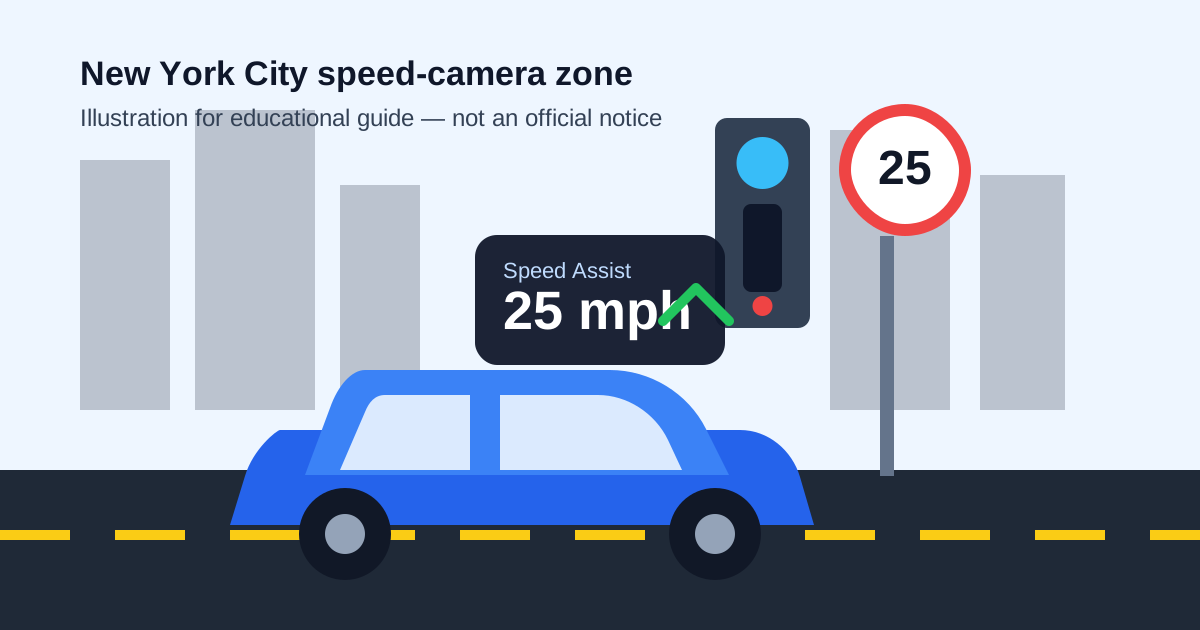
New York has authorized New York City to create a pilot program for repeat speed-camera offenders. A vehicle that receives 16 or more qualifying New York City speed-camera violations within a 12-month period may be required to use an Intelligent Speed Assistance device, with an expected initial installation period of at least 12 months. The law has been authorized, but full operational enforcement still depends on city and agency implementation.
Key Takeaways
- The measure is centered on a New York City pilot, not a statewide mandate for every driver.
- The key threshold is 16 or more qualifying NYC speed-camera violations within 12 months.
- The sixteenth qualifying violation may meet the threshold; it is not “more than 16.”
- Covered vehicles may be ordered to use active Intelligent Speed Assistance for at least 12 months, subject to final rules.
- NYC camera notices generally do not add DMV points, unlike police-issued speeding convictions.
- PIRP does not erase camera notices, dismiss tickets or cancel an ISA requirement.
What the program is
“Super speeder” is a policy and media term, not necessarily a standard New York DMV violation name. The 2026 budget measure authorizes New York City to use Intelligent Speed Assistance for vehicles with repeated automated speeding violations.
Warning-only ISA can beep or display an alert. The New York repeat-offender concept focuses on active ISA that may restrict excessive acceleration after the vehicle reaches an allowed threshold, subject to final technical specifications.
Who may be affected
The threshold should be read carefully: 16 or more qualifying New York City speed-camera violations within a 12-month period. Because camera notices are generally issued to the registered owner, final rules may connect the requirement to the owner and covered vehicles rather than only the person driving at one moment.
Final counting procedures—such as pending challenges, dismissed notices, lookback dates, company vehicles and multiple vehicles—may depend on implementing rules.
What Intelligent Speed Assistance is
ISA technology may use GPS, a digital speed-limit map, traffic-sign recognition, vehicle speed data and a connection to accelerator or engine-management systems. Some systems warn; active systems can limit further acceleration. Public legislative descriptions have discussed limiting speed to about five mph over the applicable limit, but final New York program standards should control.
Can drivers override the device?
Official implementation documents have not confirmed a specific override method. Emergency override rules, technical exceptions, map errors, temporary speed limits, equipment failures and emergency-vehicle use may depend on final regulations and approved devices.
Installation duration
The initial period is expected to be at least 12 months. Repeat requirements may lead to longer installation periods, but exact durations for individual vehicles should be verified against final notices and agency rules.
Cost and approved installers
The owner may be expected to pay for installation and use, subject to hardship support, waivers or other accommodations in final rules. Do not buy products advertised as “New York approved” until New York publishes official approved-device and installer information.
Possible noncompliance consequences
Consequences may include civil fines, compliance notices, registration-related consequences and restrictions on tampering with or bypassing a required device. Exact penalty amounts and enforcement steps should come from official notices or final regulations, not online summaries.
Is the program already operating?
The legislation was signed on May 27, 2026 as part of the Fiscal Year 2027 budget. That authorizes the framework; it does not prove that every covered vehicle is already receiving installation orders.
- Law enacted or authorization granted
- Regulations explaining operations
- Agency systems identifying covered vehicles
- Approved devices and installers
- Official notices and actual enforcement
Does it apply statewide?
The central measure concerns a New York City pilot. State authorization may allow other localities to consider related requirements under specified standards, but counties and municipalities outside NYC have not automatically adopted the same 16-notice rule.
Camera notices and DMV points
NYC speed-camera notices are generally civil notices to the vehicle owner and generally do not add DMV points because the camera identifies the vehicle, not the driver. A police-issued speeding ticket is different: an officer identifies the driver, and a conviction may carry DMV points, fines, surcharges and insurance consequences. The ISA threshold may still use repeated camera notices even when each notice individually has no DMV points.
Camera Notice Versus Police-Issued Speeding Ticket
Usually issued to
Speed-camera notice: Registered vehicle owner
Police-issued speeding ticket: Identified driver
DMV points
Speed-camera notice: Generally none
Police-issued speeding ticket: May add points after conviction
Driving record
Speed-camera notice: Generally not a driver conviction
Police-issued speeding ticket: A conviction may appear
Typical consequence
Speed-camera notice: Civil fine or notice
Police-issued speeding ticket: Fine, surcharge and possible points
Possible insurance relevance
Speed-camera notice: Usually not a moving violation, but repeated notices may signal risk
Police-issued speeding ticket: A conviction may affect insurance depending on the policy and rules
May count toward ISA threshold
Speed-camera notice: Qualifying NYC speed-camera notices may count
Police-issued speeding ticket: Depends on final program rules
Can PIRP erase it?
Speed-camera notice: No
Police-issued speeding ticket: No
| Issue | Speed-camera notice | Police-issued speeding ticket |
|---|---|---|
| Usually issued to | Registered vehicle owner | Identified driver |
| DMV points | Generally none | May add points after conviction |
| Driving record | Generally not a driver conviction | A conviction may appear |
| Typical consequence | Civil fine or notice | Fine, surcharge and possible points |
| Possible insurance relevance | Usually not a moving violation, but repeated notices may signal risk | A conviction may affect insurance depending on the policy and rules |
| May count toward ISA threshold | Qualifying NYC speed-camera notices may count | Depends on final program rules |
| Can PIRP erase it? | No | No |
PIRP: what it can and cannot do
PIRP cannot erase camera notices, dismiss police tickets, remove convictions, eliminate fines, cancel an ISA installation requirement, provide advance credit for future tickets or guarantee an insurance result.
For eligible drivers, a New York defensive driving course may improve knowledge, support better hazard and speed-management habits, reduce up to four points for DMV suspension calculations and provide a 10% reduction in eligible base liability and collision insurance rates for three years. Points do not physically disappear from the driving record.
Practical prevention advice
- Watch school-zone, work-zone and roadside speed signs.
- Do not rely only on navigation-app speed-limit data.
- Use vehicle speed alerts where available.
- Reduce speed before entering lower-limit zones.
- Review camera notices promptly for date, time, route and recorded speed.
- Identify repeat routes and patterns.
- Make sure family members and employees understand violations may accumulate against the registered owner.
- Keep registration contact information current.
Related New York resources
Compare New York defensive driving courses, learn how New York DMV point reduction works, understand New York PIRP insurance benefits, read more New York speeding-camera guidance, review auto insurance information, or explore defensive driving requirements by state.
Frequently Asked Questions
Does one speeding ticket require a speed limiter in New York?
No. The NYC pilot targets repeat automated violations, especially vehicles with 16 or more qualifying New York City speed-camera violations in a 12-month period.
Is the threshold 16 speed-camera tickets?
Yes. Current official descriptions refer to 16 or more qualifying speed-camera violations within 12 months, so the sixteenth qualifying notice may meet the threshold.
Do NYC speed-camera tickets add DMV points?
Generally, no. NYC speed-camera notices are usually vehicle-owner civil violations, while police-issued speeding convictions may add DMV points.
Does the law apply to all New York drivers?
No. The main enacted measure is a New York City pilot. Other localities would need their own authorized implementation before a similar requirement applies.
Are red-light camera violations included?
Not clearly for this NYC pilot. Earlier proposals discussed red-light camera violations, but current public descriptions focus on speed-camera violations; final agency rules should be checked.
Can a defensive driving course cancel the requirement?
No. PIRP can provide separate eligible point-calculation and insurance benefits, but it cannot erase violations or cancel a legal ISA installation requirement.
Can I install my own speed-limiting device?
Not safely as a compliance assumption. A required installation is expected to involve approved equipment and authorized installers once official lists exist.
When will enforcement begin?
The authorizing budget legislation was signed on May 27, 2026, but operational enforcement depends on New York City and agency rules, notices, systems, approved devices and installers.
The Bottom Line
New York’s super speeders measure is not a general speed-limiter mandate for every driver. The important number is 16: a vehicle with 16 or more qualifying NYC speed-camera violations in 12 months may become subject to an ISA requirement after official implementation. The safest response is to follow posted limits, pay attention to changing speed zones and correct repeat patterns early.
Official Sources
Disclaimer
This Guide is provided for general educational purposes and does not constitute legal or insurance advice. Program requirements, covered violations, implementation dates and enforcement procedures may change. Confirm information involving a particular vehicle, notice or driver with the responsible New York agency or an appropriately qualified professional.