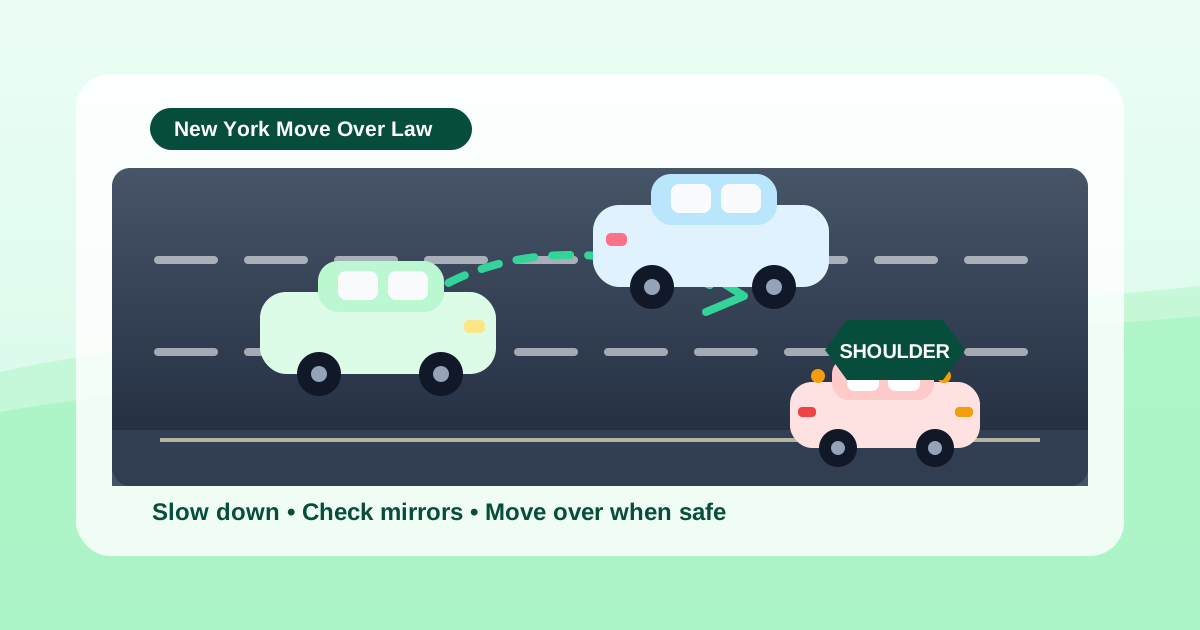
A person may be changing a tire, waiting for roadside assistance, helping a passenger or standing beside a disabled vehicle. Police officers, tow operators and highway workers face the same danger when passing traffic remains too close.
For drivers, the safest rule is simple: see a vehicle stopped ahead, slow down early and move over when it is safe.
New York Rule at a Glance
New York drivers must slow down and exercise due care around stopped roadside vehicles. On parkways and controlled-access highways, move out of the immediately adjacent lane when it can be done legally and safely.
Quick Answer
Ordinary stopped vehicles are covered on New York parkways and controlled-access highways. Drivers should reduce speed, check mirrors and blind spots, and move from the adjacent lane when safely possible.
Do not force an unsafe lane change. Hazard lights are not the only indication of a roadside hazard, and drivers should continue cautiously until the entire scene is clear.
Key Takeaways
- New York’s Move Over Law protects more than police and emergency vehicles.
- Since March 27, 2024, the law also covers ordinary vehicles stopped along parkways and controlled-access highways.
- Drivers must reduce speed and exercise due care.
- On qualifying multi-lane highways, drivers should leave the lane immediately next to the stopped vehicle when safe.
- The law does not require an unsafe lane change.
- Hazard lights are an important warning, but a vehicle without hazard lights can still be dangerous.
- People may be standing outside the vehicle or hidden from view.
- A Move Over violation is treated as a moving violation.
- Fines, points and insurance effects can depend on the exact charge and final disposition.
- Early scanning is safer than braking or changing lanes at the last moment.
What Is New York’s Move Over Law?
New York Vehicle and Traffic Law Section 1144-a requires drivers to exercise due care to avoid colliding with certain stopped or standing vehicles. The rule has long applied to vehicles such as police vehicles, fire vehicles, ambulances, tow trucks, highway-maintenance vehicles and vehicles displaying qualifying red, white, blue, green or amber lights.
The law was later expanded to protect ordinary motor vehicles stopped on the shoulder or roadway of parkways and controlled-access highways. This means a driver should not wait to see emergency lights before beginning to create space.
What Changed on March 27, 2024?
Beginning March 27, 2024, New York expanded the Move Over Law to include all vehicles stopped along the roadway on parkways and controlled-access highways.
Examples can include a family car with a flat tire, a vehicle that has overheated, a car involved in a minor crash, a driver waiting for a tow truck, a vehicle that ran out of fuel or battery charge, a car stopped because of a medical issue or a roadside-assistance vehicle helping a motorist.
The expansion recognizes that ordinary drivers and passengers face serious risk when standing beside high-speed traffic.
Does the Law Apply on Every Road?
On All Roads
Drivers must use due care and reduce speed when approaching qualifying emergency and hazard vehicles.
On Parkways and Controlled-Access Highways
When several lanes travel in the same direction, drivers approaching a stopped vehicle should leave the lane immediately adjacent to the vehicle when the movement can be completed legally and safely. Examples can include the New York State Thruway, interstate highways, parkways and other limited-access, multi-lane roads.
Do not assume that every local street requires the same lane-change action. However, slowing down and creating space remains a sound defensive-driving practice whenever a vehicle or person is exposed near traffic.
Do You Always Have to Change Lanes?
No. The law does not require a driver to create a new hazard.
Move over only when the lane change is legal, practical, controlled and safe under current traffic conditions. Do not cut off another vehicle, move into an occupied blind spot, cross a prohibited marking, swerve suddenly, force another driver onto the shoulder or lose control on snow, ice or standing water.
When moving over is unsafe, reduce speed substantially, increase following distance and pass with as much clearance as the situation allows.
How Much Should You Slow Down?
New York does not provide one universal reduced speed for every Move Over situation. The correct speed depends on posted speed limit, traffic volume, weather, road surface, visibility, shoulder width, the stopped vehicle’s position, pedestrians, emergency activity and distance from the travel lane.
A token reduction may not be enough when someone is standing only a few feet from moving traffic. The goal is to travel at a reasonable speed that gives the driver enough time to react.
A Simple Three-Step Method
1. Identify the hazard
Look for hazard lights, emergency lights, tow trucks, reflective vests, cones, flares, open doors, debris, people outside vehicles or a vehicle partly blocking a lane.
2. Create space
Check the rearview mirror, side mirror, blind spot, next-lane traffic and motorcycles approaching from behind. Signal early and move over smoothly when safe.
3. Slow down
If changing lanes is unsafe, release the accelerator, increase following distance, prepare to brake, avoid abrupt steering and pass at a controlled speed.
The memory rule is: identify, create space, slow down.
What If Traffic Is Heavy?
Heavy traffic may make changing lanes impractical. In congestion, signal early, do not force a gap, ease off the accelerator, increase space ahead, expect other vehicles to merge, watch for motorcycles, avoid stopping beside the roadside hazard and follow directions from police or workers.
A controlled slowdown in the current lane may be safer than an abrupt lane change.
What If You Are Already One or More Lanes Away?
If you are already one or more lanes away from the stopped vehicle, remain alert but do not move toward the hazard. Leave room for vehicles in the adjacent lane that may need to merge, and avoid accelerating into their blind spots.
A driver moving away from the shoulder may have limited time and space, especially near a curve, bridge, work zone or traffic backup.
What If the Stopped Vehicle Has No Hazard Lights?
Do not assume there is no danger. A disabled vehicle may have a dead battery, damaged electrical system, failed hazard lights, an injured occupant, no time to activate warning lights or a person standing outside the vehicle.
The safest response is to recognize the stopped vehicle itself as a possible hazard.
What If a Vehicle Is Partly in the Travel Lane?
Treat it as an immediate traffic hazard. You may need to reduce speed earlier, check surrounding traffic, change lanes when safe, avoid sudden braking, turn on hazard lights if traffic behind needs warning and follow police or flagger directions.
Do not stop beside the disabled vehicle unless you are providing necessary assistance and can do so safely.
What If Police or Road Workers Direct Traffic?
Follow authorized directions even when they differ from normal lane markings or signals. Police officers, firefighters, emergency personnel and authorized traffic controllers may need drivers to stop, change lanes, use the shoulder, proceed slowly, wait for equipment or follow a temporary traffic pattern.
Do not rely only on GPS or ordinary signs when a person is actively directing traffic.
What If an Emergency Vehicle Is Approaching From Behind?
This is different from passing a stopped roadside vehicle. When an emergency vehicle approaches with lights or siren, signal, pull toward the right edge when safe, stop as required, keep intersections clear and follow officer directions.
Do not confuse pulling over for an approaching emergency vehicle with moving over for a stopped roadside vehicle.
What If Your Own Vehicle Breaks Down?
Protect yourself before trying to protect the vehicle.
- Signal.
- Move as far from active traffic as possible.
- Use a wide shoulder, exit or parking area when available.
- Activate hazard lights.
- Set the parking brake.
- Call roadside assistance.
- Call 911 if the vehicle blocks traffic or creates an immediate danger.
- Stay belted inside when that is safer.
- Exit away from traffic only when a protected path exists.
- Avoid repairs next to a live lane.
Do not stand between vehicles or directly in front of or behind the disabled vehicle.
Should You Stay Inside or Leave the Vehicle?
The answer depends on the immediate hazard. Remaining inside with the seat belt fastened may be safer when the vehicle is completely on the shoulder, traffic is moving rapidly, there is no safe walking route or a barrier cannot be reached safely.
Leaving may be necessary when the vehicle is smoking or burning, stopped in a live lane, at immediate risk of being struck, authorities direct occupants to move or a safe protected location is accessible.
What Should You Carry for a Roadside Emergency?
Useful items include a charged phone, charging cable or power bank, reflective warning device, flashlight, first-aid kit, warm clothing or blanket, drinking water, tire-pressure gauge, roadside-assistance information and emergency contact details.
Place items where they can be reached without standing in traffic. Do not walk into a travel lane to position cones or triangles unless it can be done safely.
Tickets, DMV Points and PIRP Limits
A Move Over violation is a moving violation. The exact consequences depend on the section charged, roadside vehicle involved, whether there was a collision, the driver’s record, court disposition, additional violations and insurance-company rules.
A citation may also involve related offenses such as speeding, unsafe lane change, failure to exercise due care, distracted driving or reckless driving. Confirm any point value using the current DMV point table and the exact Vehicle and Traffic Law section on the ticket.
A New York PIRP course does not dismiss a ticket, erase a conviction, remove the violation from the driving record, cancel a court deadline or guarantee insurance treatment. An eligible DMV-approved course may provide separate point-calculation and insurance benefits under New York rules.
Review official PIRP information from New York DMV before enrolling for any ticket-related reason.
Seven Common Mistakes
Waiting until reaching the stopped vehicle
Looking only at the vehicle instead of people or debris
Assuming ordinary cars are not covered
Forcing a lane change
Slowing too abruptly
Accelerating after the first vehicle
Using the phone to photograph the scene
Related New York Driving Resources
For broader research, review the New York defensive driving Guide, compare New York defensive driving courses, read the New York DMV point-system Guide, review New York work-zone speed-camera rules, read the New York school-bus law Guide, review New York low-visibility driving tips, review safe-driving essentials, or browse defensive driving requirements by state.
Frequently Asked Questions
Does New York’s Move Over Law apply to ordinary cars?
Yes. Since March 27, 2024, New York’s Move Over Law includes ordinary motor vehicles stopped along parkways and controlled-access highways.
Do I have to move over for a car with a flat tire?
Yes, when the vehicle is stopped along a qualifying multi-lane highway and moving over can be done legally and safely. Drivers should also reduce speed and use due care.
Do I always have to change lanes?
No. The law does not require an unsafe lane change. If moving over is not safe, slow down substantially and pass with due care.
Is there a required reduced speed?
No single reduced speed applies everywhere. The speed should be reasonable for the traffic, road, weather, visibility and roadside hazard.
Does the law apply to tow trucks?
Yes. Tow trucks and other qualifying hazard vehicles displaying required warning lights are covered by New York’s Move Over Law.
Does the law apply on local streets?
Drivers must use due care and reduce speed around qualifying emergency and hazard vehicles on all roads. The expanded lane-change requirement for ordinary stopped vehicles applies on parkways and controlled-access highways.
What if the stopped vehicle has no hazard lights?
Slow down and create space anyway. Hazard lights may have failed, and a person may still be near the roadway.
What should I do if my own car breaks down?
Move as far from traffic as possible, activate hazard lights, call for help and avoid standing next to active traffic.
Is a Move Over violation a moving violation?
Yes. New York DMV driver-manual guidance identifies Move Over Law violations as moving violations.
Can defensive driving remove the ticket?
No. A New York PIRP defensive driving course does not dismiss a ticket, erase a conviction or cancel a court deadline.
The Bottom Line
New York’s Move Over Law is no longer only about police cars and tow trucks. Ordinary motorists stopped along a parkway or controlled-access highway also need protection.
The safest approach is to scan far ahead, slow down early, check mirrors and blind spots, move out of the adjacent lane when safe, never force a dangerous maneuver and continue cautiously until the entire scene is behind you.
Remember: see a stopped vehicle, reduce speed and create space.
Official Sources
Disclaimer
This Guide is provided for general educational purposes and does not constitute legal or insurance advice. Road layouts, citations and individual circumstances vary. Follow police and traffic-control directions and confirm questions involving a specific ticket or incident with New York DMV, the court, the issuing agency, an insurer or an appropriately qualified professional.