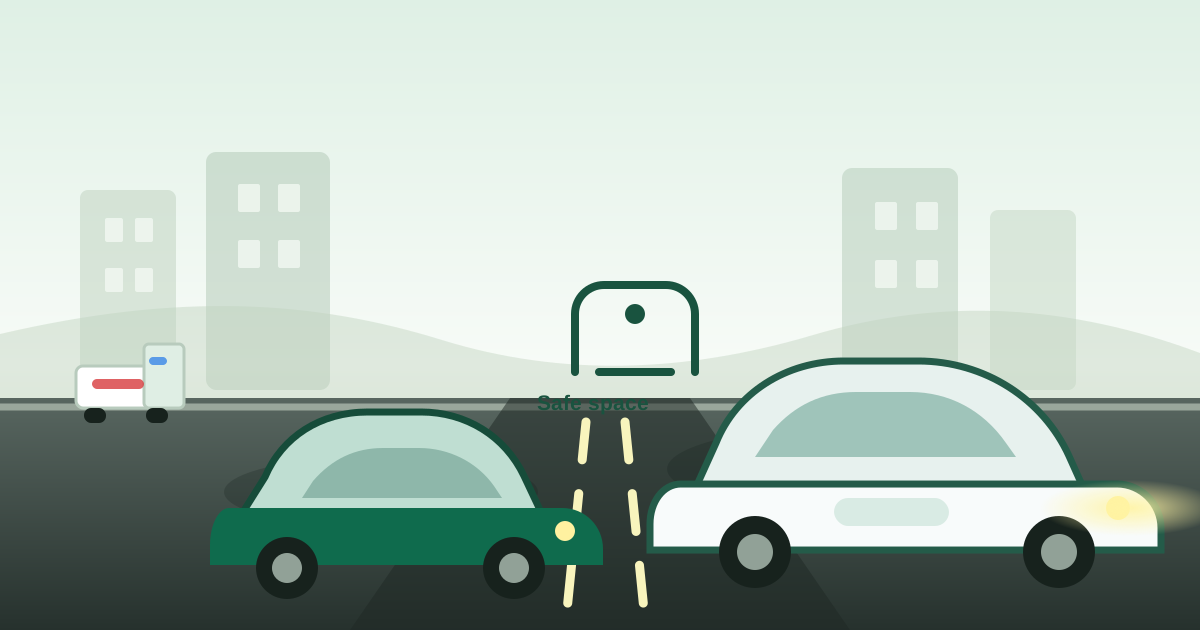
Current Update
California's autonomous-vehicle rules and local operating conditions may continue to change. Confirm current requirements through California DMV, California Legislative Information and relevant local authorities.
Quick Answer
Beginning July 1, 2026, California law allows officers to issue formal noncompliance notices when a fully driverless autonomous vehicle allegedly violates traffic rules. The notice is generally directed toward the autonomous-vehicle manufacturer or its designated representative rather than a nonexistent human driver. The law also requires covered companies to maintain emergency contact systems and provide two-way communication between nearby first responders and a remote human operator. Human drivers should continue following normal traffic laws, drive predictably and leave extra space.
Key Takeaways
- California's new autonomous-vehicle rules took effect July 1, 2026.
- Officers may document violations committed by vehicles operating without an in-vehicle human driver.
- The process uses a Notice of Autonomous Vehicle Noncompliance, not a conventional human-driver citation.
- The manufacturer or designated representative may receive the notice.
- Repeated or serious problems may lead to DMV review.
- Driverless vehicles must support communication with emergency responders.
- A driverless vehicle does not receive ordinary human-license DMV points.
- Human drivers should not brake-check, block or intentionally confuse a robotaxi.
What Changed on July 1, 2026?
Assembly Bill 1777 created additional requirements for autonomous vehicles operating without a human operator physically present. Before this change, a police officer encountering a driverless vehicle could face an obvious enforcement problem: there was no human driver available to receive a traditional citation.
The new framework allows an officer to prepare a formal noncompliance notice containing information such as the date, time, location, vehicle license plate, nature of the alleged violation, autonomous-vehicle manufacturer and other identifying details required by the process. The purpose is to create a documented record that regulators can review.
The law also introduces emergency-response requirements, including a dedicated contact line and a two-way voice communication system that allows a nearby emergency responder to communicate with a remote human operator.
Is This a Normal Traffic Ticket?
Not exactly. A traditional traffic ticket is normally issued to an identified driver, who may need to pay a fine, appear in court or respond to DMV consequences. A fully driverless vehicle has no person in the driver's seat, so California uses a separate administrative process.
The Notice of Autonomous Vehicle Noncompliance records the alleged conduct and identifies the company responsible for the autonomous-driving system. Depending on the circumstances and the manufacturer's compliance history, the DMV may review the event and determine whether further action is appropriate.
Possible regulatory action may involve requests for additional information, corrective-action requirements, review of testing or deployment practices, changes to permit conditions, or suspension or revocation of an autonomous-vehicle permit in a serious case. An individual notice does not automatically mean that a company will lose its permit.
What Kinds of Violations Can Be Documented?
The law is designed to address traffic violations that would normally be attributed to a human driver. Examples may include an autonomous vehicle running a red light, failing to stop at a stop sign, blocking an intersection, failing to yield, interfering with an emergency response, entering a restricted emergency area, failing to stop for a school bus, making an unsafe movement or remaining disabled in a travel lane.
The exact outcome will depend on what occurred, what the officer observed and how the responsible agencies apply the law. A noncompliance notice should not be treated as proof that every autonomous vehicle from the same company is unsafe.
Who Is Responsible When There Is No Driver?
Responsibility may involve the autonomous-vehicle manufacturer, the company operating the commercial service, a remote operator, a maintenance provider, the registered vehicle owner or another human road user involved in the incident.
The new notice process gives California regulators a clearer way to connect a roadway event with the company responsible for the automated-driving system. Determining legal liability after a collision is a separate issue and may depend on evidence, insurance coverage, product design, maintenance and the actions of other road users.
Why the Law Focuses on Emergency Responders
A stopped or confused driverless car can create a serious problem during a fire, medical emergency, evacuation or police response. A human driver can normally hear instructions, make eye contact, respond to hand signals and move the vehicle. A driverless vehicle may need help from a remote operator.
Under the new requirements, covered autonomous-vehicle companies must maintain a dedicated emergency-response telephone line while their vehicles are operating on public roads. Vehicles must also support two-way voice communication so a nearby emergency responder can communicate with a remote human operator.
This is especially important when a street must be cleared, fire equipment needs access, police establish a temporary perimeter, traffic signals are not working, a large event creates unusual traffic control, an evacuation route changes or an autonomous vehicle becomes disabled.
Recent San Francisco Context
The law took effect during renewed public discussion about robotaxis in San Francisco. Following the city's July 4, 2026 fireworks event, local officials said multiple autonomous vehicles became immobilized or contributed to severe congestion as large crowds and vehicles attempted to leave the area.
Some vehicles reportedly lost power and required towing. San Francisco officials have asked state regulators to consider stronger preparation, removal and emergency-coordination requirements for autonomous-vehicle companies during large events. That incident is separate from the passage of AB 1777, but it illustrates why cities want fast communication and reliable procedures when driverless vehicles cannot respond normally.
Does the New Law Apply to Tesla Autopilot or FSD?
It depends on how the vehicle is operating. AB 1777's special requirements primarily address autonomous vehicles operating without a human operator physically present.
Most privately owned vehicles using driver-assistance systems still require a licensed human driver to remain responsible for supervision and control. Systems marketed as Autopilot, Full Self-Driving (Supervised), highway driving assist, adaptive cruise control or lane-centering assistance do not automatically turn the human driver into a passenger. When a human is legally responsible for the vehicle, an officer may issue a normal citation to that driver.
What Should You Do When Driving Near a Robotaxi?
1. Drive predictably: use turn signals, stay within your lane and avoid sudden maneuvers.
2. Do not brake-check the vehicle to see how it responds.
3. Do not stand in front of a driverless vehicle or block its cameras or sensors.
4. Leave extra following distance because a robotaxi may stop conservatively.
5. At a four-way stop, follow legal right-of-way rules rather than waiting for eye contact.
6. Expect conservative behavior near turns, merges, pedestrians and double-parked vehicles.
7. Treat a stalled robotaxi like any other road hazard: slow down, avoid sudden lane changes and follow police instructions.
What If a Robotaxi Blocks Your Driveway?
Start by identifying the company operating the vehicle. Many commercial autonomous vehicles display a company name and customer-support number. If the vehicle is occupied, the passenger may be able to contact support through the ride application.
- Record the location and time.
- Note the license plate and company.
- Take photographs from a safe position.
- Contact the company's support line.
- Contact local parking or non-emergency authorities if the obstruction continues.
- Call emergency services only when the blockage creates an immediate safety emergency.
Do not attempt to push, tow or manually move the vehicle.
What If You Are in a Collision With a Driverless Car?
Treat the collision as you would any other crash, while documenting the autonomous vehicle carefully. Move to safety when possible, check for injuries and call 911 when anyone may be injured or the crash creates an immediate road hazard.
Record the autonomous vehicle's license plate, company name, vehicle identification details, location, time, road and weather conditions, photographs and video, witness contact information and police report information. Commercial autonomous vehicles are generally operated under regulatory and insurance requirements, so ask the responding officer or company representative how to obtain claim information.
A driverless vehicle may contain extensive sensor and event data, but ordinary drivers should still keep their own photographs, dashcam footage and written notes.
Can a Robotaxi Receive DMV Points?
No, not in the same way as a licensed human driver. DMV point systems are designed primarily around licensed human drivers and their convictions. A driverless vehicle does not hold a human driver's license, so the ordinary point system does not work in the same way.
Instead, California can use administrative oversight involving the manufacturer's testing or deployment permit. A human driver involved in the same incident can still receive a conventional citation and DMV points when the evidence supports it.
Do Robotaxis Have to Follow School-Bus Rules?
Yes. Autonomous vehicles must comply with applicable traffic laws, including rules involving stopped school buses. The new enforcement process gives officers a way to document a qualifying violation even when no human driver is present.
Human drivers should not copy the actions of an autonomous vehicle that appears to proceed illegally. Each driver remains responsible for following the law.
Can You Challenge or Report Unsafe Robotaxi Behavior?
Yes. A person who witnesses unsafe behavior may be able to report it to local law enforcement, the autonomous-vehicle company, California DMV, the California Public Utilities Commission when the issue involves commercial passenger service, or a local transportation or emergency-management agency.
For useful reporting, include the date, time, exact location, company, license plate, direction of travel, event description and photographs or video taken safely. Do not use a phone while driving to record the incident. Pull over safely or ask a passenger to document it.
Common Mistakes Human Drivers Should Avoid
Assuming the vehicle can see everything.
Following too closely behind a cautious automated vehicle.
Making an illegal pass around a delayed robotaxi.
Testing the vehicle by stepping into its path or creating a fake obstacle.
Touching or interfering with cameras, sensors or other equipment.
Ignoring police, firefighters or traffic-control personnel.
Assigning blame before investigators and insurers have reviewed the evidence.
Related California Driving Resources
For broader research, compare California defensive driving courses, review California driving requirements, read the California DMV retest Guide, read more California driving-law Guides, review safe-driving essentials, or browse defensive driving requirements by state.
Frequently Asked Questions
Can California police ticket a driverless car?
Yes, California officers can now issue a Notice of Autonomous Vehicle Noncompliance for qualifying violations involving a fully driverless vehicle. It is an administrative process rather than a conventional citation handed to a human driver.
When did the new California driverless-car law take effect?
The relevant provisions of AB 1777 took effect on July 1, 2026.
Who receives the autonomous-vehicle noncompliance notice?
The notice may identify and be directed toward the autonomous-vehicle manufacturer or its designated representative.
Does a driverless car receive DMV points?
No, not in the same way as a licensed human driver. California generally addresses autonomous-vehicle violations through manufacturer and permit oversight.
Does the law apply to a Tesla using supervised FSD?
Generally, a human driver using a supervised driver-assistance system remains responsible for the vehicle. That driver can receive a conventional traffic ticket.
What should I do if a robotaxi stops unexpectedly?
Slow down, leave space and change lanes only when it is legal and safe. Do not drive through a bike lane or onto a sidewalk to pass it.
What should I do if a robotaxi blocks my driveway?
Start by recording the time, location, license plate and company from a safe position, then contact company support and local non-emergency authorities if the obstruction continues.
Can I report unsafe robotaxi behavior?
Yes. Depending on the situation, reports may be made to law enforcement, the operating company, California DMV or the California Public Utilities Commission.
What should I do after a crash with a driverless car?
Check for injuries, contact law enforcement when appropriate, photograph the scene and collect the company, license plate, witness and police-report information.
Do robotaxis have to follow school-bus laws?
Yes. Autonomous vehicles must comply with applicable traffic laws, including rules involving stopped school buses.
The Bottom Line
California's 2026 law closes an important enforcement gap. When a fully driverless car breaks a traffic rule, an officer no longer has to treat the absence of a human driver as the end of the process. The officer can document the alleged violation and connect it to the company responsible for the automated-driving system.
For ordinary drivers, the practical rule is simple: drive predictably, leave extra space and do not challenge or test a robotaxi. Driverless technology may change who receives an enforcement notice, but it does not change the basic responsibilities of everyone sharing the road.
Official Sources
- California Legislative Information: Assembly Bill 1777
- California Highway Patrol: Public Safety Laws Taking Effect in 2026
- California DMV: Autonomous Vehicles
- California DMV: Autonomous Vehicle Testing and Deployment Regulations
- California Public Utilities Commission: Autonomous Vehicle Passenger Service
Recent Reporting
Disclaimer
This Guide is provided for general educational purposes and does not constitute legal or insurance advice. Autonomous-vehicle regulations, operating permits and enforcement practices may change. Confirm requirements involving a specific incident with California DMV, law enforcement, the vehicle operator or an appropriately qualified professional.